

Issue 52, 2026 (Total Issue No. 240)
On the day your fifth hospital goes live, does the founder still have to fly in?
It sounds like an operational detail. It is actually a fundamental commercialization test.
Depression technology is advancing at unprecedented speed. Digital therapeutics are entering formal clinical guidelines, while novel neuromodulation platforms are delivering striking early data. Major regulatory milestones are being crossed across the United States, China, and Europe.
However, the hardest questions begin after the evidence arrives.
A medical technology can be clinically validated, regulator-cleared, and actively generating revenue—and still lack a repeatable commercial model. That is because proof that a technology works is not proof that a complex health system can absorb it at scale.
Across recent depression-tech deployments, three commercialization hurdles consistently stall growth.
Hurdle 1: Regulatory approval proves efficacy, not repeatable deployment
On December 29, 2025, Wangli Technology (望里科技) received China’s first Class III medical device registration for a prescription digital therapeutic in mental health, its WL-iCBT.
In its pivotal registration trial, the product demonstrated an eight-week response rate of 63.15% and a remission rate of 50.68%. China’s 2025 depression treatment guidelines subsequently awarded it a 1A recommendation.
These are exceptional clinical milestones. But regulatory approval fundamentally shifts the strategic question.
-
- Before clearance, management asks: Can we prove that this technology works?
-
- After clearance, management must ask: Can an ordinary clinical organization adopt this repeatedly without extraordinary support from us?
Early hospital revenue routinely hides massive operational subsidies. Hospital one has an influential, highly motivated department head. Hospital two receives bespoke clinical onboarding. Hospital three gets direct, on-site support from the vendor’s engineering team.
The software contracts count as revenue, but buried inside that line item are unpriced costs: manual workflow redesign, custom IT integration, heavy clinical-ops staffing, and direct executive attention.
This is why gross contract value is a misleading metric for scale. A far more revealing metric is the intervention decay rate: As deployments expand, how quickly does vendor intervention decline?

If hospital five requires the same founder involvement, custom training, and clinical support as hospital one, the company is scaling top-line revenue without actually scaling its delivery model.
Ask the uncomfortable version of the question: When hospital five goes live, does the founder still have to fly in?
If the answer remains yes, you don’t have a repeatable deployment model yet. You have software wrapped inside a high-touch, unscalable consultancy.
Hurdle 2: Prescription, activation, and payment are three distinct engines
This distinction is vital for modern depression therapeutics like Rejoyn, developed by Otsuka and Click Therapeutics. FDA-cleared in 2024 as the first prescription digital therapeutic for major depressive disorder symptoms, Rejoyn experimented with access economics at launch—offering a temporary $50 self-pay rate alongside a $200 list price for insurance coverage.
Founders often view payment pathways as a linear ladder:
Self-Pay → Insurance Coverage → Scale
In reality, these are completely different commercial engines, not sequential rungs:
-
- Self-pay requires consumer marketing efficiency, price elasticity, rapid onboarding, and immediate out-of-pocket value.
-
- Reimbursement requires health-economic studies, complex billing codes, payer contracting, and institutional physician education.
Neither engine automatically solves the conversion chain that sits between clinical clearance and repeatable revenue:
Prescribed → Activated → Fulfilled → Paid

Each arrow represents a distinct operational friction point:
-
- A payer can reimburse a product that physicians rarely prescribe.
-
- A physician can prescribe enthusiastically for an app patients never activate.
-
- A patient can activate software that payers refuse to cover.
Payer coverage answers only one question: Will someone pay? It does not answer: Will clinicians prescribe, will patients start, and will patients stick with it?
Hurdle 3: Efficacy must survive clinical operational reality
The third hurdle begins much earlier—during initial hardware and software R&D.
In May 2026, Paris-based Sonomind raised €20 million to advance a focused-ultrasound approach for treatment-resistant depression. Its first-in-human open-label study showed striking initial data: across five patients receiving 25 five-minute ultrasound sessions over five days, average depression severity fell by approximately 61% with no serious adverse events.
The underlying neuroscience is compelling. Commercially, however, the delivery constraints dictate its ultimate reach.
Treatment planning in the initial protocol required CT imaging, MRI, tractography, and patient-specific acoustic metalenses. While entirely appropriate for an early clinical trial, these requirements introduce core operational friction points for commercial rollout:
-
- Where does this procedure physically occur inside a busy psychiatric center?
-
- How many minutes of specialist time does treatment planning consume per patient?
-
- What happens when the procedure leaves an academic research centre and enters a routine outpatient clinic?
This is the efficacy trap: A technology performs brilliantly inside the tightly controlled environment of a trial, only for the company to realize too late that the surrounding clinical workflow is too complex, expensive, or slow for routine adoption.

Designing for commercialization belongs inside early R&D. Before hardware specifications or software architecture freeze, teams must ask:
-
- Does this design require specialized infrastructure our target customer does not currently own?
-
- Does every treatment session consume scarce physician or specialist hours?
-
- Are we engineering operational steps out of the workflow as aggressively as we are improving biological effect size?
This isn’t premature commercialization—it is engineering for survival in a real-world clinic.
The Strategic Framework: Four Keys, Not One Milestone
Healthcare commercialization isn’t a single door; it’s a four-key interlock:
- The Patient (Adherence): Will they start and stay? Measures activation friction, cognitive load, user journey complexity, and out-of-pocket tolerance.
- The Clinician (Workflow): Can they fit it into a 15-minute consult? Measures clinical setup time, consultation disruption, and per-order monitoring burden.
- The Institution (Infrastructure): Can the health system absorb it? Measures IT security clearance, EHR integration overhead, staff training, and spatial constraints.
- The Payer (Economics): Is there a viable, predictable billing pathway? Measures health-economic evidence, reimbursement coding, settlement cycles, and pricing elasticity.
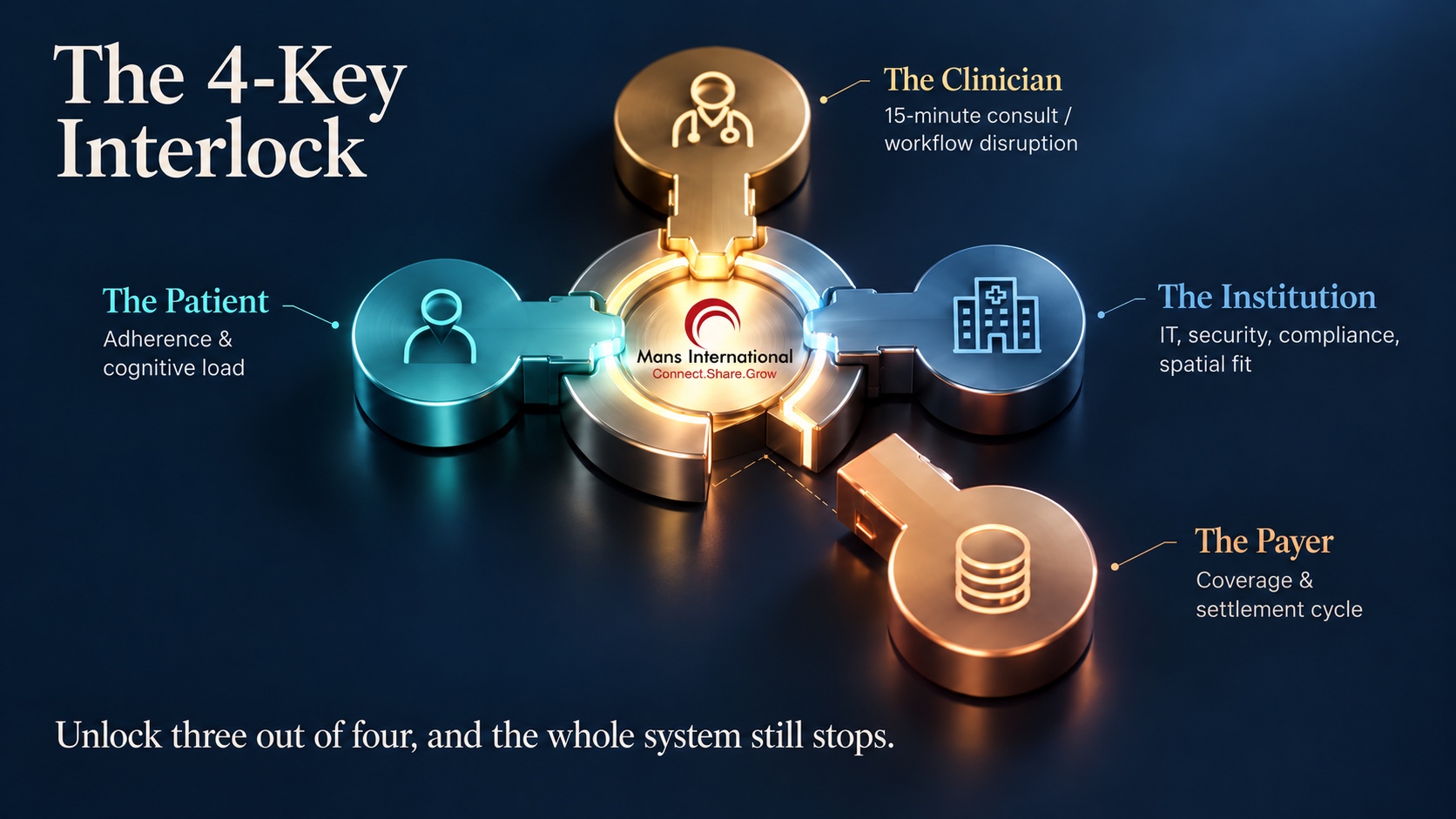
Meeting three out of four conditions does not equal 75% success. In healthcare systems, one persistently locked gate stops the entire commercial pathway.
Execution Discipline: Pre-Commit to Your Failure Conditions
To avoid burning growth capital on unrepeatable models, introduce one key rule before launching the next expansion phase: Explicitly state the hypothesis the capital is meant to test, and pre-commit to your failure criteria before spending a dollar.
If funding a deployment expansion across ten hospitals, move beyond simple volume targets:
Unhelpful Goal: Deploy software across ten hospital sites.
Operational Hypothesis: Deployment becomes progressively less dependent on vendor intervention over time.
Then, establish the non-negotiable failure threshold upfront:
“If hospital five still requires more than 10 hours per week of vendor implementation support three months post-launch, we deem the deployment model unscalable. We will immediately freeze sales expansion and revisit product onboarding, training, and workflow configuration before opening new sites.”

Without explicit pre-committed criteria, executive teams fall into the trap of reinterpreting friction after the budget is spent:
-
- Heavy vendor hand-holding is relabeled as “customer success.”
-
- Low patient activation is excused as “an unusually difficult clinical population.”
-
- High-cost custom integration is framed as “strategic learning.”
Capital ends up subsidizing individual exceptions rather than proving a scalable model.
Unfinished Test: From Ji Ji to Wei Ji
The I Ching (Book of Changes) offers a subtle warning about these pivotal inflection points.
Hexagram 63 is Ji Ji (After Completion)—milestones achieved, goals met. But the book does not end there. It concludes with Hexagram 64: Wei Ji (Before Completion)—things open, evolving, and unfinished.

In health-tech commercialization:
-
- Regulatory clearance feels like Ji Ji.
-
- Closing hospital one feels like Ji Ji.
-
- Securing initial coverage feels like Ji Ji.
Yet every completed milestone simply creates the conditions for the next structural test.
Before allocating capital to your next growth phase, ask three fundamental questions:
- Which specific operational uncertainty is this money explicitly meant to remove?
- Whose daily decisions must change for the business model to work—the patient, clinician, IT reviewer, or payer?
- What empirical evidence proves that each additional deployment requires less intervention per unit, rather than more?
The third question is the Fifth Hospital Test.
The true test of enterprise value isn’t whether your team can make hospital one work through sheer force of will. It’s whether hospital five can run smoothly without you ever getting on a plane.
Note: Wangli’s clinical figures reflect company-reported registration trial data. Sonomind’s efficacy results come from a 5-patient first-in-human open-label study and represent early proof-of-concept. Rejoyn pricing reflects 2024 launch positioning. This article is business commentary and does not constitute medical, financial, or investment advice.