
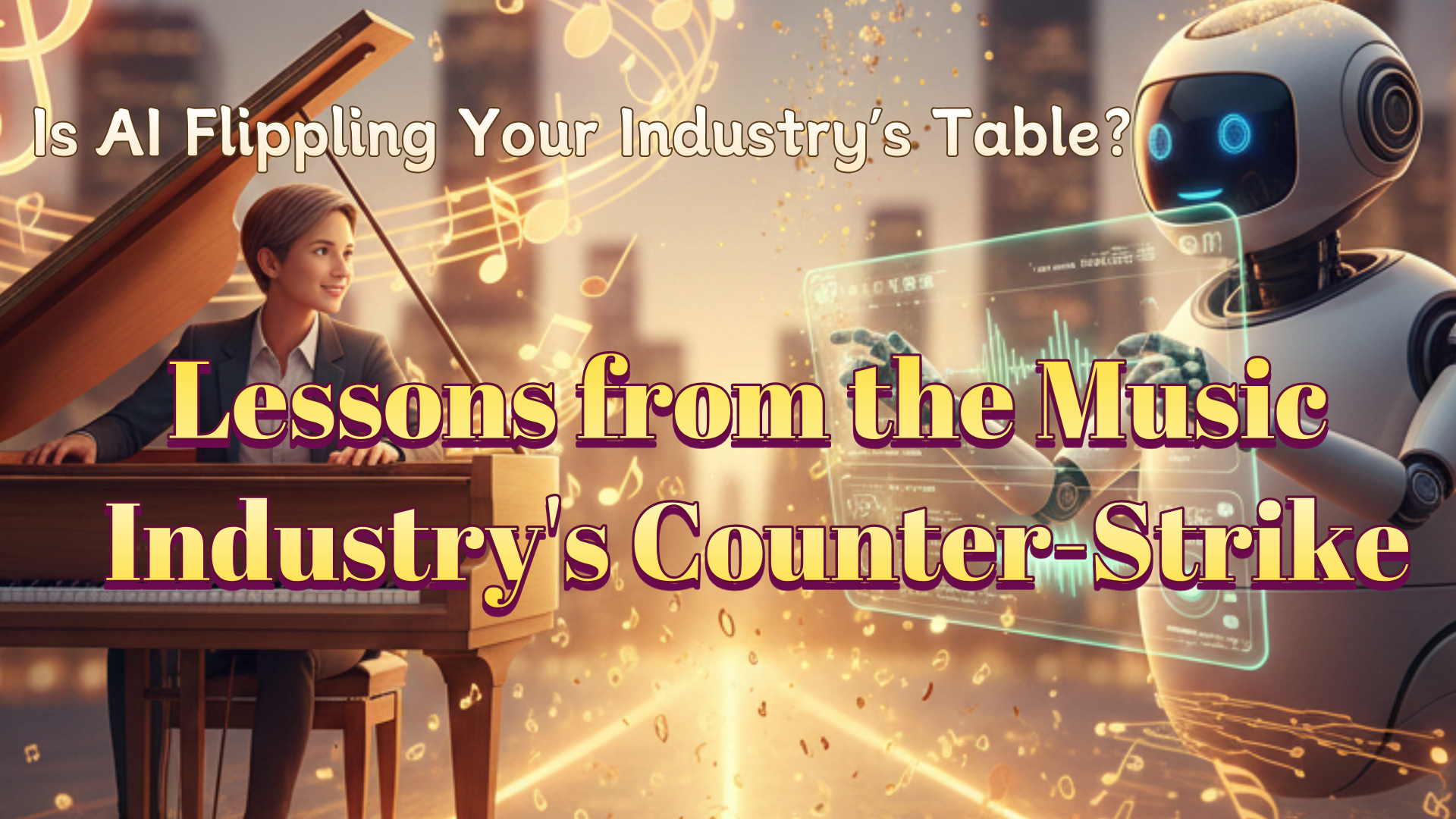
Is AI Flipping Your Industry’s Table? Lessons from the Music Industry’s Counter-Strike
I. The “Good Enough” Trap is Killing Your Margins.
If your core revenue comes from “deliverables” — code, copy, design, or scoring — 2026 isn’t just another year of tech updates. It’s a survival crisis. Not because AI is extraordinary. But because “good enough” is now almost free.

II. How Musicians Responded: Stop Producing. Start Defining.
The music industry was one of the first to feel this shock. We saw AI-generated tracks, such as Breaking Rust’s “Walk My Walk,” top the Billboard charts by tapping into raw human sentiment. We saw icons like Yuan Yawei “reverse-cover” AI versions of their own songs to reclaim the narrative.

But the most instructive response wasn’t about competing with AI on output.
It came from a pioneering Chinese game-audio studio, Xiaoxu Music, which asked a far more uncomfortable question: Why do clients hire us at all? The answer was clarifying. Clients weren’t buying music. They were buying atmosphere.
The Shift: They transformed from a content shop into an Experience Architect.

They began delivering end-to-end immersive solutions for theme parks, cultural tourism projects, shopping centres, and live events — integrating:
- AI-generated music and visual content
- Live performers and musicians
- Physical staging, lighting, and spatial design
AI didn’t replace them; it became the invisible engine inside a new, higher-value layer.
III. The “Manus” Signal: Leverage vs. Fulcrum
Many leaders still believe the solution is simple: “Teach the team AI tools.” That’s necessary — but insufficient. Tools are leverage. Direction is the fulcrum.
In late 2025, Meta acquired Manus for over $2 billion. Manus didn’t win by building the biggest LLM. They won by being the Ultimate Orchestrator. By layering models (like Alibaba’s Qwen) and focusing on the Agentic Layer — the ability to understand intent, plan complex tasks, and execute across silos — they proved that the “Moat” is no longer in the math, but in the integration of the human problem.
As the I Ching, or Book of Changes, suggests: “Ride the six dragons to steer the heavens.” The wise don’t fight the storm; they harness the wind to go where others cannot.
IV. The Question Every Decision-Maker Must Answer
In an AI-saturated world, the strategic challenge is no longer: “What can AI replace?”
The real question is: “What layer of value am I uniquely qualified to own?” Call it your “AI Fusion Layer.” AI will rapidly eliminate roles, products, and companies that refuse to redefine themselves. So don’t wait for the rules to settle. They won’t.

If you can’t beat the wave — ride it. And take it somewhere it has never been.
Are you still figuring out your AI Fusion Layer? Let’s connect to discuss where your moat lies in the age of the Agent.

You may also like