From a Cloud Robotics Vision to a RMB 3 Billion Restart: What Hard-Tech Founders and Investors Must Rethink
Kelly’s Global Tech Intelligence #244 | Issue 56, 2026
Mans International | SMAF Case Study #13
01 | A Book Foreword, and the Engineer Behind the Vision
While preparing this case study, I remembered something for which I have always been deeply grateful.
Mr. Bill Huang (黄晓庆) carefully read my English book and generously wrote a foreword for it. I have never forgotten his encouragement and trust.
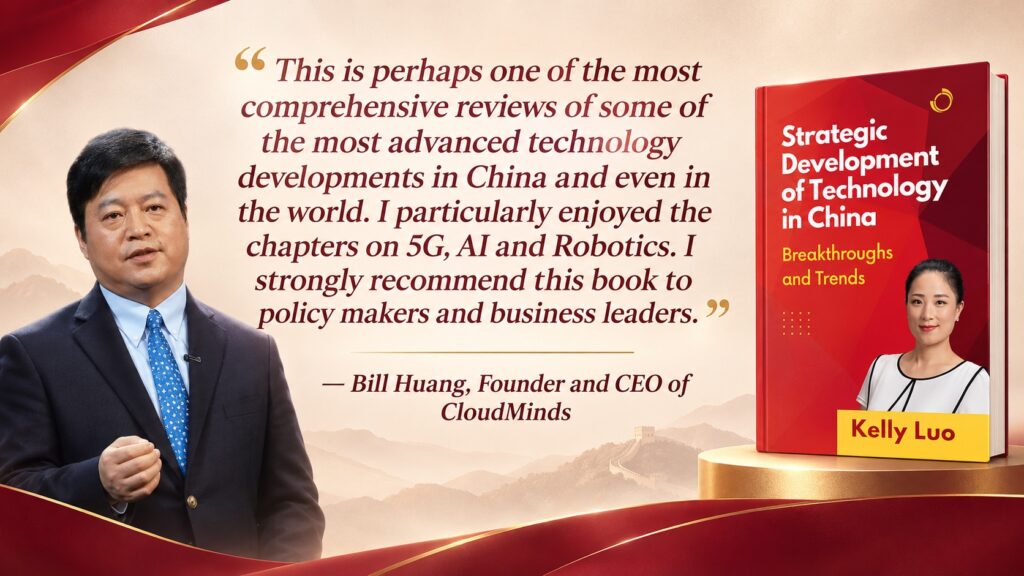
Bill’s career spans several defining chapters in modern telecommunications. From AT&T Bell Labs and UTStarcom to leading the China Mobile Research Institute, he helped advance software-based telecommunications switching and China’s transition from 3G to 4G, including the internationalization of TD-LTE.
In 2015, he founded CloudMinds with another ambitious vision: connecting cloud intelligence, secure networks, and robotic terminals into a new architecture for intelligent machines. His career reflects a consistent willingness to challenge technological boundaries.
But pioneering an architectural paradigm and building a commercially sustainable enterprise are fundamentally different challenges.
In October 2025, the Beijing Fangshan District People’s Court accepted a bankruptcy liquidation case involving CloudMinds Robotics (Beijing) Co., Ltd.—a proceeding concerning a specific legal entity within the broader group footprint.
By August 2026, Datta Robotics (Jinan) (达塔机器人), led by Bill alongside core members of the original team, secured seed financing at a reported pre-money valuation of RMB 3 billion.
The determination to pursue a technological vision through setbacks commands respect. So does accountability to those affected along the way; media reports indicate former employees faced unpaid wages and severance.
This journey raises a decisive question for every hard-tech founder and venture investor:
Is true entrepreneurial resilience about remaining unyielding to the original vision—or developing the executive judgment to change how that vision is commercially realized?
02 | Technology Can Lead the Market; Business Cannot Wait Forever
What renders CloudMinds an invaluable case study is not simply its technological ambition, but the structural distance between its strategic vision and commercial maturity.
Given Bill’s telecommunications background, treating cloud, network, and robotic terminals as a unified ecosystem was a natural strategy with vast long-term imagination. Shared cloud compute, a unified robotic OS, and cross-terminal orchestration may well underpin the future of robotics.
However, technological potential does not automatically translate into repeatable customer demand.
CloudMinds’ 2019 U.S. SEC prospectus revealed that cloud robotics and services accounted for only 12.1% of total revenue in 2018, dropping to 3.2% in H1 2019. Hardware distribution and system integration outside the core cloud robotics vision generated the bulk of monetization.
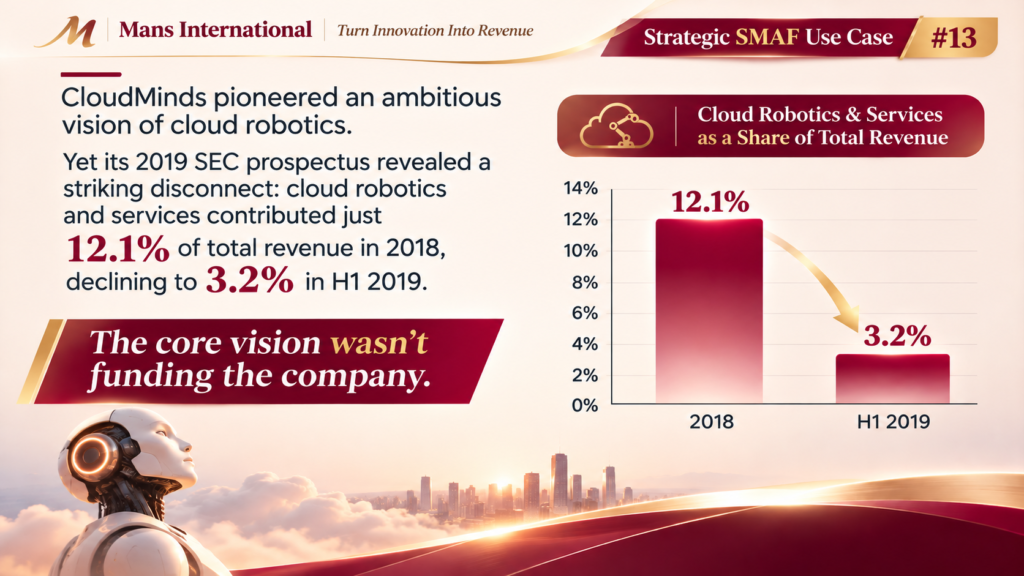
These figures do not invalidate cloud robotics. They expose a classic hard-tech friction point: the central technological vision had not yet become the primary revenue engine.
Hard-tech entrepreneurs routinely face this trap: technological breakthroughs precede market readiness, platform construction demands heavy upfront capital, and enterprise adoption takes years.
The greatest risk is rarely instantaneous technical failure, but expanding a capital-intensive organization long before sustainable unit economics have been proven. The critical question is not whether the technology will eventually matter, but whether the company can survive—and adapt intelligently enough—for that future to arrive.
03 | Mans International SMAF: From Technological Vision to Scenario Maturity
At Mans International, I use the Scenario Maturity Assessment Framework (SMAF) to identify structural bottlenecks preventing technical innovation from becoming sustainable economic value.
The core diagnostic question is: Does a technological capability solve a recurring operational problem that customers will pay for on an ongoing basis?
Three distinctions matter:
- Demonstration vs. Deployment: An impressive robot demo does not establish operational reliability inside a client’s daily workflow.
- Pilot vs. Repeat Order: A subsidized pilot project does not prove the existence of a repeatable, line-item purchase order.
- Valuation vs. Validation: Advanced patents, strategic partners, and high pre-money valuations do not automatically validate commercial model durability.
Media reports on CloudMinds’ later difficulties point directly to this gap: flexible actuators accounted for over 60% of humanoid robot costs, the GingerXR was priced above RMB 200,000, and revenues relied heavily on non-repeatable government and enterprise pilot grants.
Technology maturity determines what a product can do; commercial maturity determines why customers need it on an ongoing basis. Grounding a technology stack requires operating in scenarios where the buyer’s financial ROI is immediate, clear, and scalable.
04 | Judgment Trail: What Really Changed in the Second Startup?
Datta Robotics (Jinan) securing new funding gives the team’s core vision another turn at market validation.
From Mans International’s Judgment Trail perspective, one inquiry supersedes all others: Has past entrepreneurial experience fundamentally transformed executive decision logic?
In a recent conversation with Bill Huang, he acknowledged that CloudMinds’ past operating struggles involved external macro shifts in capital availability. But he also pinpointed an essential internal realization:
“As technology entrepreneurs, we need to be more conservative in financial management—and that is often what we lacked in the past.”
Datta’s current posture signals a notable strategic shift: pivoting toward open hardware, releasing reference-design robot platforms, and building an “8S” sales and service network to cultivate an Android-style robotics ecosystem.
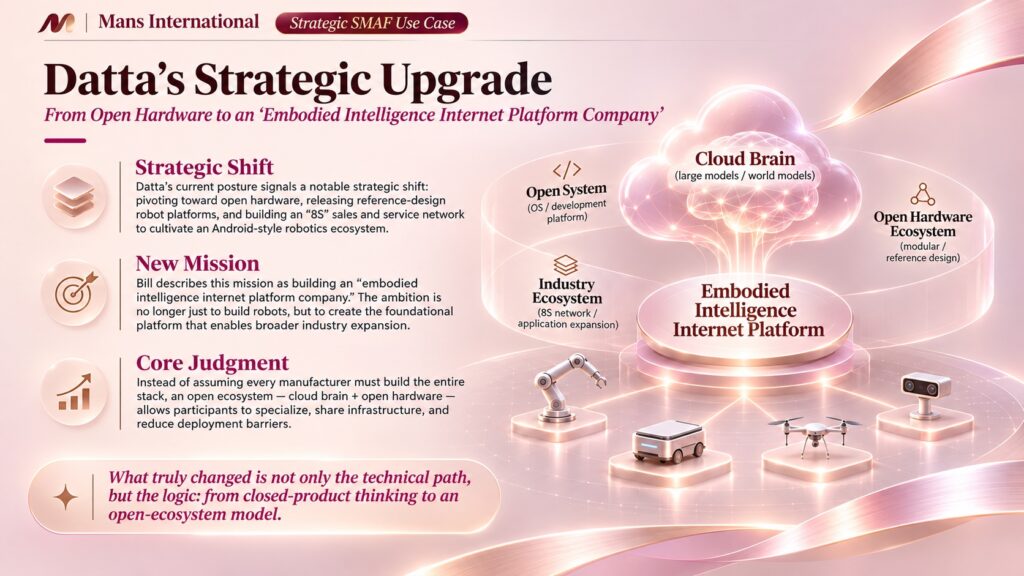
Bill describes this mission as building an “embodied intelligence internet platform company.” Instead of assuming every manufacturer must build the entire stack, an open ecosystem (“cloud brain + open hardware”) allows participants to specialize, share infrastructure, and reduce deployment barriers.
An Exclusive Conversation with Bill Huang: From Architecture to Operator Logic
During our conversation, I wanted to explore how Datta intends to address the operational bottlenecks that have historically stalled robotics commercialization.
Kelly Luo | Mans International:
“Facing industry pain points like broken unit economics, long-tail corner cases, and network scaling thresholds, what unique approach does Datta bring to its new blueprint?”
Bill Huang:
“If you look at these problems through the lens of an ‘operator,’ the solutions become very clear. We do not need every robot to become an all-powerful super brain. We need an operating framework to ensure commercial reliability.
- Constrain Terminal SOPs First: Let robots execute only what they do best at the lowest cost, protecting positive gross margins from day one.
- Super-Agent Platform + Human-in-the-Loop: When complex long-tail edge cases arise, back-office human operators step in using a telecom Network Operations Center (NOC) model to relieve local operational burden.
- Regional Centralized Density: Focus on achieving a tight commercial closed loop in specific regions to maximize scale effects and network density.”
This marks an essential perspective shift: solving robotics commercialization may depend less on maximizing individual machine autonomy than on optimizing the economics and reliability of the entire operating system.
The Strategic Takeaways
For Hard-Tech Founders
Resilience is neither blind perseverance nor running the same operational playbook under a new corporate entity. It is Decision Architecture in action: updating assumptions, financial discipline, and resource allocation when reality contradicts the original plan.
For Hard-Tech Investors
Capital deployment should align with Scenario Maturity rather than technical milestones alone. Factoring in infrastructure, human-in-the-loop oversight, and long-tail maintenance costs before financing aggressive expansion is critical to long-term viability.
For the Robotics Industry
The next stage of embodied intelligence may be shaped less by individual hardware breakthroughs and more by scalable operating systems, service networks, and unit-economic discipline.
Conclusion | Another Definition of Resilience
Bill Huang once wrote a foreword for my book. Today, analyzing his path and engaging in direct dialogue with him, my respect for his technological ambition remains steadfast.
CloudMinds left behind profound questions that demand industry reflection. Datta Robotics represents a renewed attempt to answer them, but the ultimate validation will depend on operational execution and market evidence.
Resilience is not simply the courage to start again. It is the capacity to make superior decisions because of what you have learned.
That conviction drives our ongoing research at Mans International into SMAF, Judgment Trail, and Decision Architecture.
This article is the 13th installment of the Mans International SMAF Case Study Series. It draws on public records, direct strategic dialogue with Bill Huang, and independent market analysis. Statements regarding Datta’s strategy reflect founder commentary and should not be construed as verified financial results or investment advice.